


























































































Pakistan Takes Taliban Threat to World Stage at Turkmenistan Summit

At the International Peace Forum held in Turkmenistan on Friday, Pakistan Prime Minister Shehbaz Sharif urged the international community to consider sanctions against the Afghan Taliban government, citing growing security threats emanating from Afghan territory. The forum was organised to mark Turkmenistan’s 30 years of permanent neutrality, bringing together global leaders to discuss peace, trust and international cooperation.
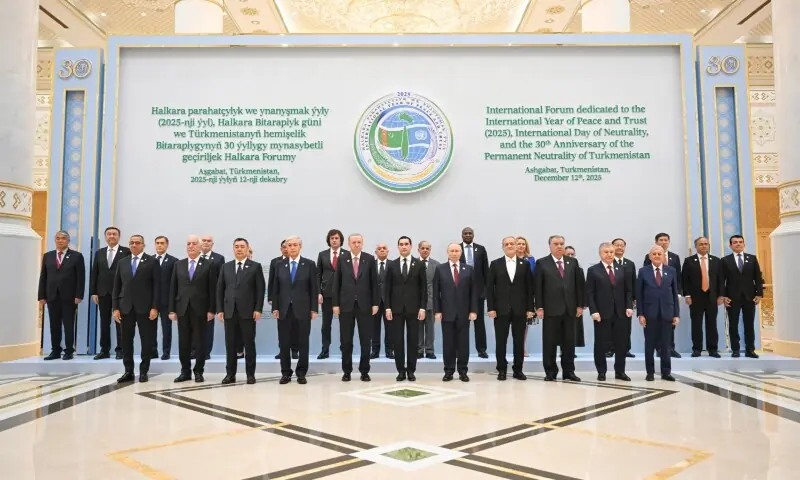
Speaking at the Maslahat Köşgi Palace in Ashgabat, Sharif reaffirmed Pakistan’s commitment to counter-terrorism and global peace, stressing the crucial role of collective international action in addressing cross-border security challenges. He used the platform to draw attention to what he described as a renewed wave of extremist activity originating from Afghanistan, placing Pakistan’s security concerns firmly on the international agenda.
Referring to what he termed the “new wave of terrorism on Afghan soil,” the prime minister argued that sustained international pressure and accountability mechanisms could help curb militant activity. He emphasised that terrorism posed not only a national threat to Pakistan but also a broader danger to regional and global stability.
Among the high-profile attendees at the forum were Turkish President Recep Tayyip Erdogan and Iranian President Masoud Pezeshkian, with whom Sharif held targeted bilateral meetings on the sidelines of the summit. During these engagements, he reiterated his call for a coordinated global response to extremist groups operating in and from Afghanistan.
In separate talks with the Turkmen leadership, both sides reaffirmed their intention to strengthen bilateral cooperation, particularly in enhancing land and sea connectivity. These initiatives form a key pillar of Islamabad’s broader regional strategy aimed at diversifying trade routes and expanding energy partnerships across Central Asia.
The summit, hosted in Turkmenistan’s capital, drew presidents, prime ministers and senior representatives from across the world, highlighting a shared emphasis on peace, mutual respect and strengthened diplomatic relations at a time of growing geopolitical uncertainty.
This is not the first time the Afghan Taliban government has faced accusations of fostering terrorism at the international level. Earlier this year, Iran presented a report to the United Nations Security Council, urging greater UN engagement in addressing Afghanistan’s worsening humanitarian crisis. The report highlighted deepening food insecurity, widespread malnutrition and severe inequalities, particularly affecting women and children, alongside persistent security concerns.
Beyond security, Sharif framed Pakistan’s foreign policy as grounded in a broader vision that links peace with sustainable development and climate resilience. He underscored that global cooperation must address terrorism alongside climate change, poverty and inequality, describing these challenges as deeply interconnected threats to long-term stability.

“We must recognise that climate change, poverty, and inequality are not isolated challenges,” Sharif told the assembly. “These are transnational threats that require solutions built on shared responsibility, unity of purpose, and equitable access to technology and resources.”
By placing security threats, especially terrorism emanating from Afghan territory, alongside environmental and socioeconomic vulnerabilities, Sharif sought to broaden the definition of peace beyond the absence of conflict, presenting it instead as a foundation for long-term stability, development and prosperity.
His core message remained clear: international norms of non-interference must not prevent decisive action against terrorist groups that threaten neighbouring states, and Pakistan’s security concerns should not be treated as purely bilateral matters.
As the forum concluded, Pakistani officials described Sharif’s participation as a diplomatic success, noting that he had successfully elevated Pakistan’s security concerns within a multilateral setting while advancing discussions on regional connectivity, sustainability and development.